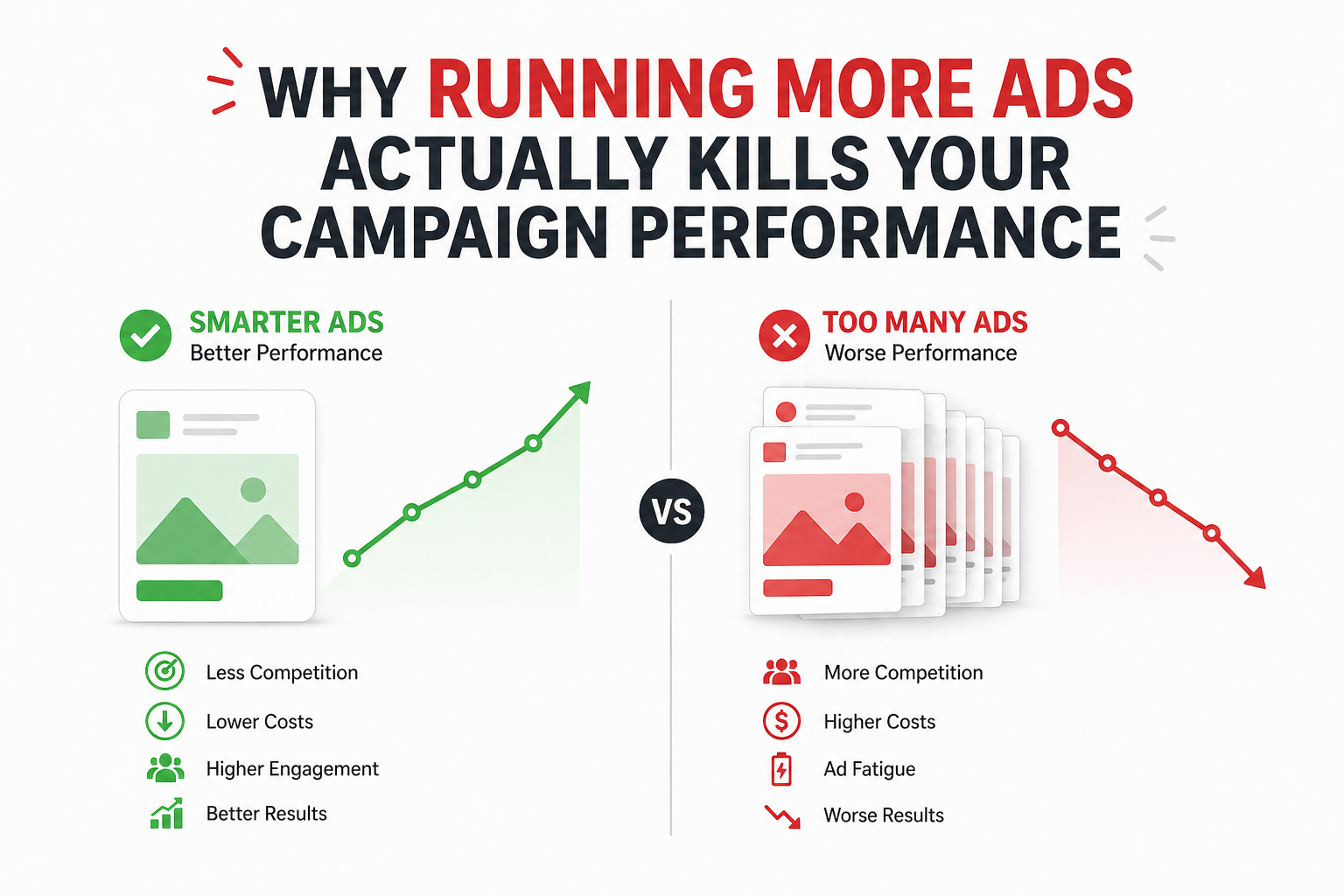

When things stop working, doing something feels better than doing nothing. Launch a new ad. Try a different headline. Add another ad group. It feels like action, and action feels like progress.
But here’s what nobody tells you upfront — that instinct is costing you money. A lot of it. I’ve seen ad accounts with 40+ active creatives pulling a 0.8x ROAS while a leaner competitor with 4 ads was sitting at 5x. Same budget, same city, same audience. The difference had nothing to do with creative quality. It was structure.
If you’re running or planning to run performance marketing in Jaipur — whether it’s for an e-commerce brand, a local service, or a D2C startup — this is probably the most important thing to understand before you spend another rupee on ads.
The Moment Everything Goes Wrong
Picture this. You launch a Meta campaign. Week one looks decent — decent CTR, some conversions, nothing to complain about. Then week two hits. Numbers dip. Your CPA goes from ₹180 to ₹320 overnight. So what do you do?
Most people panic and start launching new variations. New creatives. New audiences. New ad sets targeting slightly different interests. Before you know it, you’ve got 15 ad sets running on a ₹600/day budget. That’s ₹40 per ad set per day. Not enough for even one conversion event in most niches, let alone the 50 that Meta needs to exit the learning phase.
The algorithm is now completely confused. It doesn’t know who to target. It’s getting mixed signals from 15 different targeting setups. And you’re sitting there wondering why performance tanked further after you “fixed” it.
Internal Competition — Your Own Ads Fighting Each Other
Here’s something a lot of beginners in performance marketing in Jaipur miss entirely. If the same audience sees ads from different ad sets, they’re basically fighting for the same spot. You end up bidding against yourself. Your CPM goes up not because the market got more expensive — but because you made it more expensive for yourself.
Meta and Google both have mechanisms to partially prevent this, but they’re not perfect. The best way to avoid this? Don’t create the overlap in the first place. Keep your ad sets focused and your audiences clearly separated—smaller, cleaner structures almost always perform better.
What the Algorithm Actually Needs From You
People treat ad algorithms like a magic box. Put money in, get sales out. But it doesn’t really work like that. Google and Meta rely on data to optimize, and without enough data, things fall apart. Consistent, quality data.
When you keep launching new ads every few days, you’re resetting the learning cycle constantly. The algorithm never gets enough runway to figure out which users convert. It’s basically like changing a salesperson every two days and expecting results. You’ll never see their best performance.
This is one of the core things covered in the digital marketing course in Jaipur at Briwon Academy. Before students ever touch bidding strategies or creative frameworks, they’re taught campaign architecture — because a bad structure will kill even the best creative.
The Learning Phase: Stop Interrupting It
Meta Ads needs roughly 50 conversion events per ad set per week to fully exit the learning phase. That threshold exists for a reason. Below it, the algorithm is still guessing. Above it, things stabilize and delivery becomes more predictable.
Now do the math. If you have ₹30,000/month and you’re running 8 ad sets, each set gets about ₹1,000/day in total — wait, no, ₹125/day each. In most categories in Jaipur, a conversion costs anywhere between ₹150 to ₹500. So you’re not even getting one conversion per ad set per day. You will never exit the learning phase. Ever.
Consolidate to 2-3 ad sets. Give each one ₹500-600/day. Give it some space to run. You’ll reach that 50-conversion mark much faster, and that’s when things usually start making sense.
Ad Fatigue Is Real — And You’re Causing It Faster Than You Think
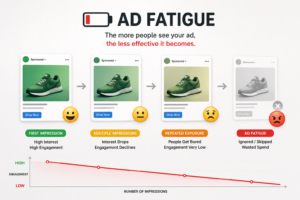
There’s another problem that comes with running too many ads, and it creeps up quietly. Ad fatigue.
When the same audience keeps seeing your ads — especially multiple variations of a similar message — they go blind to it. Click rates drop. People start hiding your ads. Meta’s system picks up on this negative feedback and starts penalizing your delivery. Your CPM spikes, reach drops, and suddenly even a good ad starts performing like a bad one.
Funny thing is, when ads start to fatigue, most marketers just launch more ads.. But that just accelerates the problem. The audience isn’t tired of your product. They’re tired of being bombarded.
For businesses doing performance marketing in Jaipur, this matters a lot. Jaipur-specific audience pools — say, people interested in wedding services, real estate, or coaching institutes — aren’t as large as metro cities. You can saturate a local audience surprisingly fast if you’re not careful about frequency.
Watch for These Numbers Before It’s Too Late
If your Meta frequency crosses 3.5 on a cold audience within a 7-day window, that’s your warning sign. Pair that with a falling CTR or rising CPM and you know fatigue has set in. The fix at that point isn’t more ads — it’s pulling back, refreshing creatives, or shifting to a broader audience for a while.
Budget Dilution: The Quiet ROI Killer
Let’s talk money. Specifically, what happens to your money when it gets spread across too many campaigns.
Say your monthly budget is ₹1,20,000. That sounds decent. But if you’ve split it across 10 campaigns targeting different products, different cities, different demographics — each one is getting ₹12,000/month or ₹400/day. In a competitive category, ₹400/day is barely enough to gather statistically meaningful data in a week, let alone make optimization decisions from it.
You’re not running 10 campaigns. You’re running 10 underfunded experiments that never have enough data to succeed. And when they all underperform (which they will), it feels like the platform isn’t working. But the platform is fine. The problem is you gave it nothing to work with.
The 80/20 Rule Applies Here Too
In every ad account I’ve ever audited, the pattern is always the same. A small fraction of campaigns — usually 2 or 3 — are doing the heavy lifting. Everything else is just noise that’s eating into the budget of those winners.
The job isn’t to make all 10 campaigns work. The job is to find the 2 that are actually working and funnel everything into them. Kill the rest. It feels wrong to do this, especially when you’ve invested time building those campaigns. But sentimentality is expensive in performance marketing.
Okay, So What Should You Actually Do?
Less, but better. That’s the whole philosophy.
Start with one campaign. One ad set. Three creatives — a video, a carousel, and a static image. Give it a real budget. Try to hit around 5–7 conversions daily, then give it 7–10 days without touching it. And yeah, if day 2 or 3 looks bad, don’t panic—it’s still learning.
After the learning phase, look at what’s working. Which creative has the lowest CPA? Which one has the best scroll-stop rate? Double down on that. Pause the underperformers. Then slowly introduce a second ad set — maybe a different audience or a slightly different angle.
Scale by 20-30% budget increments every 3-4 days once you’re consistently hitting your target CPA. Don’t double the budget overnight. That resets the learning phase and often breaks a winning campaign.
This exact approach is what’s drilled into students at Briwon Academy’s digital marketing course in Jaipur. Not theory — actual campaign management workflows that agencies and in-house teams use in the real world.
A Real Account, Real Numbers
A fashion brand running performance marketing came to us with a Meta account that had 19 active ad sets, 3 active campaigns, and a ₹90,000/month budget. Their ROAS over the last 60 days? 1.3x. They were losing money slowly and blaming it on “bad creatives.”
We paused everything. Ran a 2-week audit. I went back and found their two best-performing ad sets from a few months ago. Then rebuilt everything from scratch—1 campaign, 3 ad sets, 4 creatives. Same ₹90,000 budget, just more focused.
By day 45, ROAS was at 3.9x. By day 60, it crossed 4.5x. Nothing changed except the structure. Same audience, same city, same product. Just fewer ads with more budget behind each one.
That’s the power of less.
The Takeaway (And Why Most Marketers Ignore It)
Running more ads feels productive. It looks like hustle. But performance marketing isn’t about hustle — it’s about precision. The marketers who consistently hit strong ROAS numbers are usually the ones with the simplest account structures. Clean. Focused. Patient.
If you’re a business owner trying to figure out performance marketing in Jaipur, or a marketer who keeps hitting the same walls with paid ads — audit your account before you launch anything new. Count how many active ad sets you have. Look at how much budget each one is getting. Chances are, the problem isn’t your creative. It’s your structure.
And if you want to genuinely learn how to build campaigns the right way — from account structure to bidding strategy to creative testing — Briwon Academy’s digital marketing course in Jaipur is worth looking into. The curriculum is built around practical, hands-on learning with real ad accounts. Not just theory that sounds good in a classroom.
More ads won’t save a broken campaign. Better thinking will.

